Awards for outstanding achievements in astronomy
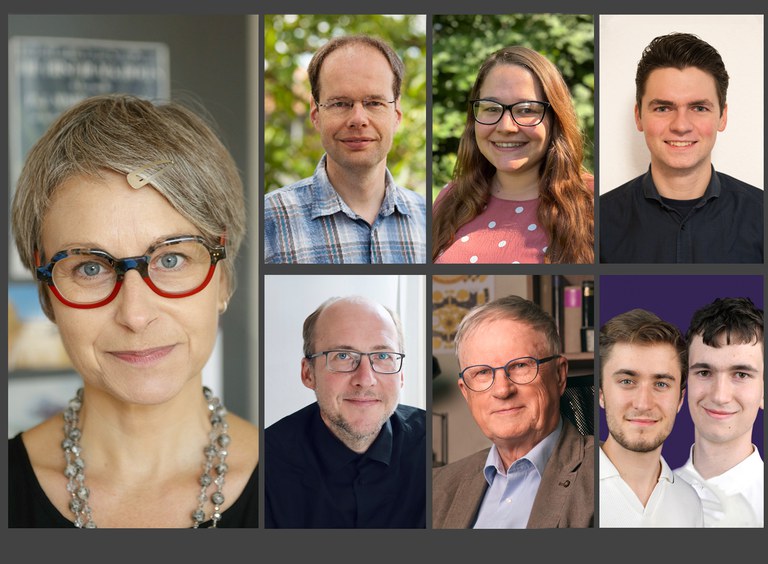
The German Astronomical Society (AG), the German national professional association for astronomy and astrophysics, has named its awardees for 2026: Marta Volonteri is awarded the Schwarzschild Medal, Cornelis P. Dullemond receives the Astrophysical Software Award , the Ludwig Biermann Award goes to Caroline Gieser, Maximilian Häberle is awarded the Doctoral Thesis Award, the Bruno H. Bürgel Prize goes to Florian Freistetter, the Hans-Ludwig Neumann Prize honours Klaus Hünig, and Alexander Leukert and Leon Heinisch received the Jugend-forscht Special Prize.
The Karl Schwarzschild Medal 2026 is awarded to Marta Volonteri, Directrice de Recherche at the Institut d’Astrophysique de Paris (CNRS), in recognition of her pioneering contributions to our understanding of the formation and evolution of massive black holes and their role in shaping the Universe. Her work has fundamentally advanced our understanding of how black holes with masses of millions to billions of solar masses form in the centers of galaxies and how their evolution is intimately connected to the assembly of galaxies and large-scale cosmic structures. Through a combination of theoretical modeling and interpretation of observations, she has revealed the crucial interplay between black hole growth, galaxy formation, accretion processes, stellar dynamics, and the evolution of the high-redshift Universe. Prof. Volonteri obtained her PhD in Astronomy from the University of Milan in 2003. Prior to joining the CNRS in 2012, she was Assistant Professor and subsequently Associate Professor with tenure at the University of Michigan, Ann Arbor, from 2007 to 2011. Earlier in her career, she held research positions at the Institute of Astronomy of the University of Cambridge and at the University of California, Santa Cruz.
For his conception, development, and long-term stewardship of the radiative transfer software RADMC-3D, the AG awards the Astrophysical Software Prize 2026 to Cornelis P. Dullemond. RADMC-3D has become an influential and widely used software package in astrophysics, providing researchers with a robust framework to model dust and gas radiative transfer and to generate synthetic observables that can be directly compared with astronomical data. Its flexibility and reliability have made it a standard tool in fields ranging from protoplanetary disks and star formation to evolved stars, and active galactic nuclei. Through its broad adoption across the international community, RADMC-3D has played a key role in transforming theoretical models into testable predictions and has enabled significant advances in our understanding of the Universe. Prof. Dullemond received his PhD in Astrophysics from Leiden University in 1999. Following postdoctoral positions at the Max Planck Institute for Astrophysics in Garching, he joined the Max Planck Institute for Astronomy in Heidelberg as Senior Postdoctoral Researcher and later as a Group Leader. Since 2010, he has been Professor at Heidelberg University.
Caroline Gieser receives the Ludwig Biermann Award 2026 in recognition of her outstanding contributions to our understanding of the physical and chemical processes that govern star formation. Combining cutting-edge observations with advanced astrochemical modeling, her pioneering studies of high-mass star-forming regions provided the first observational constraints on the density and temperature structures of massive protostellar cores and demonstrated how chemical evolution can be used to trace the earliest stages of star formation. Her work is distinguished by a uniquely holistic approach that combines observations with sophisticated physical and chemical modeling, yielding fundamental insights into the evolution of star-forming environments across a wide range of masses and evolutionary stages. Caroline Gieser obtained her PhD from Heidelberg University and the Max Planck Institute for Astronomy in Heidelberg in 2022. Following a postdoctoral appointment at the Max Planck Institute for Extraterrestrial Physics in Garching, she returned to the Max Planck Institute for Astronomy, where she continues her research on the formation of stars and planetary systems.
The AG awards its Doctoral Thesis Award 2026 to Maximilian Häberle in recognition of his groundbreaking contributions to the study of black holes and stellar systems. As part of his doctoral research, he created an unprecedented astrometric catalog for more than 1.4 million stars in Omega Centauri, the most massive stellar cluster in the Milky Way. He identified a small population of fast-moving stars in the cluster’s core and demonstrated that their motions can only be explained by the presence of an intermediate-mass black hole with a mass exceeding 8,000 solar masses. This discovery represents the first firm detection of an intermediate-mass black hole and resolves a long-standing question in astrophysics regarding the existence of black holes that bridge the gap between stellar-mass and supermassive black holes. He conducted his doctoral research at the Max Planck Institute for Astronomy in Heidelberg and is now independent postdoctoral fellow at the European Southern Observatory in Garching.
Florian Freistetter receives the Bruno H. Bürgel Prize 2026 in recognition of his outstanding success in bringing astronomy to broad audiences through books, podcasts, blogs, and live performances. His books have brought astronomical concepts and discoveries to a wide readership. Through highly successful formats such as Astrodictum Simplex, one of the most widely read science blogs in the German-speaking world, as well as podcasts like Sternengeschichten and Das Universum, and columns such as Freistetters Formelwelt, he has made astronomy accessible, engaging, and relevant to a broad and diverse audience. He studied astronomy earned his doctorate at the University of Vienna. Following research positions at several institutions, including in Jena and Heidelberg, he transitioned in 2011 to a career as an independent science writer and communicator. Since 2015, he has also been a member of the renowned Austrian science-comedy ensemble Science Busters, which combines scientific accuracy with humor to engage audiences in new and innovative ways.
The Hans-Ludwig-Neumann Prize 2026 is awarded to Klaus Hünig for his lifelong dedication to innovative and hands-on astronomy education. Beginning in the 1980s alongside his work as a teacher, he developed educational models and construction kits that enabled students to explore astronomical phenomena through direct hands-on experience. Over the years, this work expanded from astronomy to mathematics, physics, and optics, resulting in a remarkable collection of teaching materials that are used in schools throughout the German-speaking world. Following his retirement from school teaching, Klaus Hünig devoted himself entirely to the development of educational materials through his AstroMedia publishing house. His models, kits, and teaching aids continue to serve as valuable resources for educators and students alike, while his enthusiasm for science communication is further reflected in his educational YouTube channel “Klaus erklärt,” where he explains scientific concepts and demonstrates his models in an accessible and engaging way.
Alexander Leukert and Leon Heinisch from Isolde-Kurz-Gymnasium in Reutlingen won the 1st prize in geo- and space sciences in the national competition "Jugend forscht" (youth's research) and received the special prize awarded by the German Astronomical Society for work in the field of astronomy. In their project, they investigated whether the trajectories of satellites located between a planet and its moons can be predicted. Alexander Leukert and Leon Heinisch developed their own mathematical model to study satellite orbits. They analyzed a star–planet–moon system and examined the stability of orbital trajectories. In doing so, they discovered that small, closed orbits are possible near certain points between a planet and its moons.
The award ceremonies will take place during the annual meeting of the German Astronomical Society in Garching from September 7-11, 2026.
More information:
Awards of the AG: https://www.astronomische-gesellschaft.de/en/activities/awards
Annual AG Meeting 2026: https://ag2026.astronomische-gesellschaft.de